
Where every engagement starts
Your Team Respects You.
Do They Follow Without You There?
Fourteen days. An evidence-based read on how your direct reports, peers, board or investors, and key customers actually experience your leadership, and one behaviour to change because of it.
What it is. A 14-day structured multi-rater read on how your direct reports, peers, board and key stakeholders actually experience your leadership. Not a self-assessment, and not a 360 that lists forty competencies and leaves you paralyzed.
- Measures three things that gate each other: Trust, then Proactivity, then Productivity (TP3™)
- Questions are not fixed. Custom questions are added per engagement from what the kickoff call surfaces about your organization
- For an individual leader it ends with one behavior to change and a 90-day plan. For a team it ends with the one to three things that team needs to change and a 90-day plan to implement them, run through the Executive Impact System
- Your time: a 45-minute intake call and a 90-minute debrief and coaching call. Each stakeholder spends about fifteen minutes
Not ready for the full diagnostic? Take the free CEO Bottlenecks Scorecard →
Trusted by leaders at






How is this different from a 360 review?
A conventional 360 rates a leader against a long list of competencies and returns a report that is comprehensive and, for that reason, hard to act on. This measures three dimensions, TP3™, Trust then Proactivity then Productivity, and produces one decision instead.
- One-size-fits-all survey
- Lots of numbers and a pile of quotes
- No clear focus, no plan, no follow-through
- Generic "leaders like you should..." tips
- Uses questions customised to your role, goals, and business
- Includes a 90-minute debrief that turns insight into visible commitments, not guilt
- Ends with a concrete 90-day plan with tools and checkpoints
- Shows you 1 to 3 specific behaviours that will change how key people experience you
- Combines simple TP3™ scores (Trust, Proactivity, Productivity) with deep qualitative themes
This isn't an HR exercise. It's a CEO Dependency Audit for the person at the top.
Who is it for?
Senior leaders in genuinely complex organisations. The practical qualifier is not company revenue but structure: this leader has multiple direct reports each earning $200K or more per year. That is the proxy for a real leadership team with real delegation stakes.
Common triggers:
- Decisions that should close two levels down keep reaching the top.
- Revenue has been flat for several years despite real effort.
- Two senior leaders are in conflict and it is slowing the organisation.
- A leader is about to be promoted and the decision is currently a judgement call.
- A high-stakes transition is landing on one person.
How Do I Know If I'm the Bottleneck?
You are likely the bottleneck if decisions stall when you are unavailable, if your direct reports bring you problems rather than proposed solutions, and if you regularly do work that sits below your level because it is faster than delegating it. The clearest test is to count, for one week, how many items reached you that a direct report should have closed.
Most leaders discover the real figure is higher than their impression of it, because absorbing a decision takes four minutes and leaves no trace.
Why Does Everything Escalate to Me?
Because the boundary is unwritten. When a leader has not been told, out loud, what they are allowed to decide without checking, sending it upward is the only risk-free option available to them. They are behaving rationally.
This compounds quietly. Every time a problem lands on your desk and you solve it because solving it is faster than sending it back, you teach your team that bringing it to you works. One second-generation owner of a technical training company put it plainly: her team had been trained to bring problems up, and each time leadership dived straight into solving them, it created, in her words, a vacuum that pulled every problem upward.
Is It a Delegation Problem or a Capability Problem?
Ask what happens when the person is told the decision is theirs. If they make it and it is broadly sound, you had a delegation problem. The authority was never clear. If they cannot make it even with explicit permission and support, you have a capability problem, and that is a different conversation.
Most leaders assume the second and have the first. That assumption is expensive, because it leads to replacing people when the actual fix was a one-page standard. A diagnostic separates the two by showing whether the people around a leader experience them as unclear or as genuinely over-matched. That is a question performance reviews will not answer.
- State three things with every assignment: the outcome, the deadline, and the decision authority. Most delegation states the first two and leaves the third to be guessed.
- Write the escalation standard with the team, not for them. One page: what closes at their level, versus what carries real policy or risk exposure. A rule the team helped write gets followed.
- Return it the same day. When something lands on your desk that should not have, send it back that day with the reason and the owner's name. Absorbing it "just this once" is what trains the team to bring it again.
In their own words
Leaders Who've Done the Work
"We came with a clear problem: communication breakdowns and a lack of trust. In just a few short months, we've seen measurable improvements. Better communication, stronger accountability, and a roadmap for the next 90 days."
 Jonathan KurljacCEO, iBallistix
"Hearing leaders talk about how they'd use what they learned to help team members they'd been struggling with was inspiring. We all grow when we have better tools like this to bring back to the organization."
 Brian BrucknerPresident, Bruckner's Truck & Equipment
"I was so impressed that I extended his coaching to my VPs and SVPs. Working with Alex was transformative, his insightful strategies shifted my mindset, and I took impactful risks with positive results."
 Jourdan HathawayChief Business Officer, General Assembly
Measured, not asserted
What the Work Has Produced
See the actual output
Look at It Before You Decide
Every diagnostic ends with two views: one for the CEO or sponsor looking across the whole team, and one for each leader. Both are below as live samples for a four-leader team at a multi-location trucking and parts company. The team, the company and the scores are illustrative, but the format, the depth and the wording are exactly what you receive.
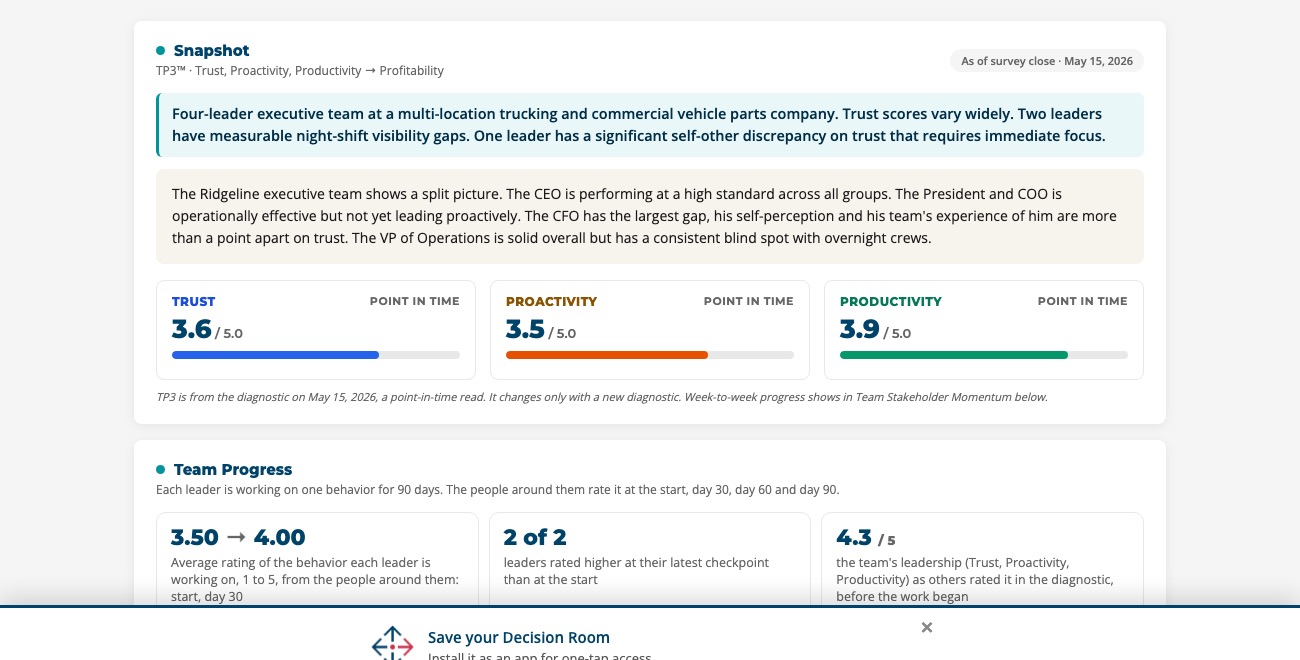
The team report a sponsor sees
TP3 scores across the leadership team, where the gaps sit, and what to address first.
Open the sample →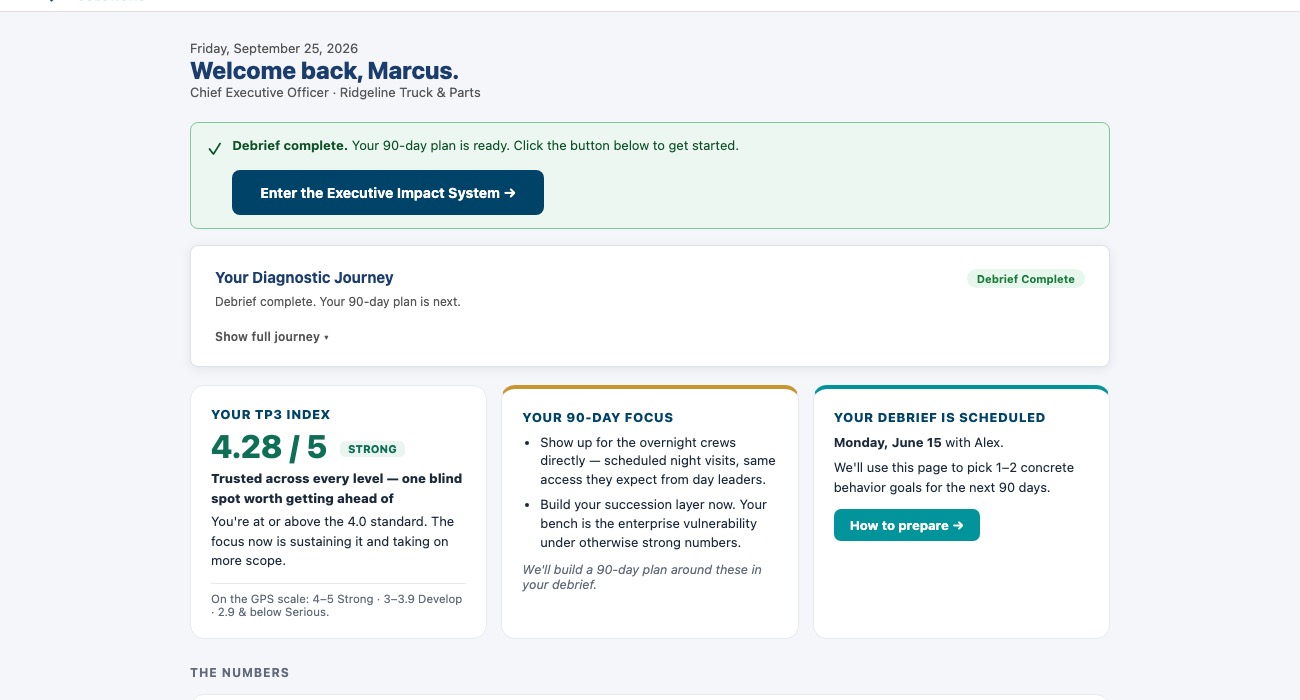
What each leader logs into
Their own scores, their 90-day focus, and their debrief.
Open the sample →Samples use a fictional company, Ridgeline Truck & Parts. Real reports are private to your organization.
What Happens Over the Fourteen Days
Your next seven days. Write down the one thing you believe your direct reports would say about your leadership if it cost them nothing to say it. Keep it. Compare it to the diagnostic result. The distance between those two is the fastest read available on how well you currently see yourself.
What you get
What You'll Walk Away With
A clear picture of how your leadership actually lands with the people who matter most.
Simple TP3™ scores so you can see exactly where you are building speed, and where you are creating drag.
The top 3 strengths you should protect and double down on.
The top 3 development priorities that are quietly slowing execution, ownership, or trust.
A 90-day Leadership Impact Plan.
A Start, Stop, Continue list that translates pages of feedback into concrete behaviours your people are literally asking you to change.
One to two practical tools matched to your focus, so you are not trying to change everything at once.
An optional 12-week follow-up pulse to see what has actually changed.
Standard, Stakeholder Survey
Per leader
- Kickoff and stakeholder mapping
- TP3™ report and full analysis
- 90-minute debrief and coaching session
- 90-Day Leadership Impact Plan
"People problems are really profit problems, and most CEOs in this room are solving the wrong one."
Alex D. Tremble, HDA Truck Pride Annual Meeting 2026Who you're working with
Built for This Work. Not Borrowed From Another.

Alex Tremble is the founder of GPS Leadership Solutions and the creator of TP3™, the 4C™ Connection Model and the 3R Relationship Model™. He has published five leadership books and been invited twice to address the HDA Truck Pride annual meeting.
The work runs on one engine, whatever the sector: clarify the real outcome, expose the honest gap, force the real choice. He is not the domain expert in your business, he is the person who reduces a complex, emotionally loaded situation to the two or three things that actually matter, so a capable leader can decide and move.
Clients span commercial truck dealers, multi-location parts distribution, logistics, banking and Fortune 500 divisions.
Frequently asked
Questions Executives Ask
How much does the 14-Day Executive Leadership Diagnostic cost?
Standard is $5,000 per leader and includes the stakeholder survey, a written report, a 90-minute debrief and a 90-day plan. Pro is $10,000 per leader and adds structured stakeholder interviews. Where a leader continues into a 90-Day Executive Reset, the diagnostic investment is credited toward it within the offer window.
Will my team actually be honest?
Ratings are confidential and reported in aggregate, with small groups combined so individual responses cannot be identified. In practice stakeholders are markedly more candid in a confidential instrument than in any conversation, which is precisely why the results tend to surprise capable leaders rather than confirm what they expected.
Is this just another 360 survey?
No. A 360 scores a leader against many competencies and returns a report. Trust, Proactivity and Productivity are the base here, and we add custom questions drawn from a kickoff call about the pressure your organisation is actually under, so the assessment asks about your situation rather than a generic one. The output is one behaviour to change and a 90-day plan for changing it, not a scorecard.
What if the diagnostic tells me something I don't want to hear?
That is the most useful outcome available. The common result is not that a leader is disliked. It is that people respect them and experience one specific behaviour as costly. Knowing which behaviour, precisely, is what makes it fixable in 90 days rather than indefinitely.
Who is the diagnostic for?
Senior leaders with multiple direct reports each earning $200K or more per year, in organisations complex enough that delegation carries real stakes. That structural test matters more than company revenue.
Can we do this without disrupting the business?
Stakeholders spend about fifteen minutes each. The leader spends the kickoff and a 90-minute debrief. The fourteen-day window is deliberately short so the assessment does not become a project that competes with the work it is meant to improve.
What is TP3™?
TP3™ is GPS Leadership's performance model: Trust, then Proactivity, then Productivity, which together drive Profitability. It is sequenced because each dimension gates the next. Where trust is low, leaders withhold information and execution slows; where proactivity is low, every decision escalates; where productivity is low, effort produces activity rather than outcomes.
Do you need experience in my industry?
No, and it is usually an advantage not to have it. The work is not about the technical domain. It is about the gap between what a leader says they want and what their daily behaviour produces. That pattern is the same in a parts distributor, a national logistics operator and a Fortune 500 division.
Find What Is Slowing Your Business Down
Fourteen days from kickoff to a debrief and a written 90-day plan. If you would rather start smaller, the free scorecard takes ten minutes.
Request the 14-Day Diagnostic Take the Free Scorecard